Understanding Shares
Is a High Dividend Yield Always Good News?
By Oluwadamilola Ojo · 22 November 2026 · 3 min read
Is a High Dividend Yield Always Good News?
Dividend yield tells you how much a share pays you in dividends each year compared with its price. It is shown as a percentage:
Dividend yield = dividend per share in a year ÷ share price × 100 |
If a share costs ₦100 and pays ₦8 in dividends a year, its dividend yield is 8%. It is a quick way to compare the cash income from different shares, and with what a savings account or treasury bill pays.
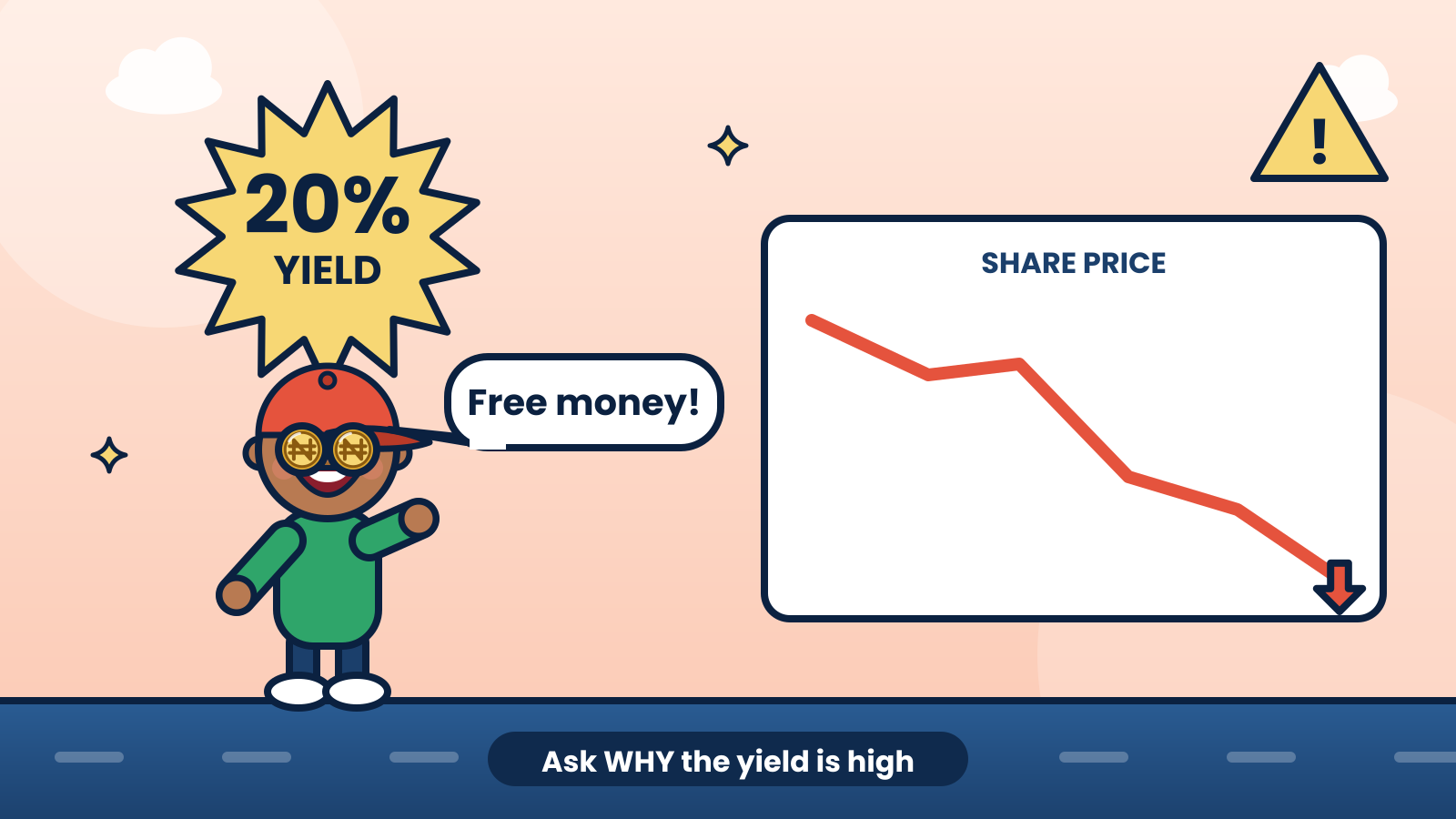
But yield has a trap. Because the share price is at the bottom of the calculation, the yield goes up when the price falls. A very high yield can be a sign of a generous company, or a sign that the market has stopped believing the dividend will last.
Here in Nigeria
Many Nigerian investors buy shares mainly for dividends, especially in banks, cement, telecoms and some consumer companies. You will often see lists of "high dividend yield stocks" in business news around results season.
Two Nigerian factors make yield harder to read:
Inflation. When inflation is high, an 8% yield may not keep pace with rising prices.
One-off dividends. Some companies pay a special dividend after selling an asset or having an unusually good year. If you divide that one-off amount by the price, the yield looks high, but it may not be repeated.
A yield is usually calculated using last year's dividends. It tells you what happened, not what will happen.
A simple example
Three made-up companies, each with a share price of ₦50 today:
Company |
Dividend last year |
Yield |
What is behind it |
Coastline Cement |
₦3.50 |
7% |
Steady profits, dividends paid for many years |
Harbour Insurance |
₦7.50 |
15% |
Price fell from ₦90 to ₦50 after a profit warning |
Sunrise Foods |
₦10.00 |
20% |
Included a one-off special dividend from selling a factory |
Sunrise Foods looks the most attractive at 20%. But if next year it goes back to its normal ₦2.50, the real yield at ₦50 is only 5%. Harbour Insurance's 15% yield exists because the price crashed. If its profits keep falling, the dividend may be cut, and the yield was a mirage.
Coastline's 7% looks the least exciting, but it may be the most reliable.
Why this matters to you
Yield is a useful starting point, not a conclusion. When you see a high yield, ask three questions:
Why is it high? Has the price fallen sharply? Was there a one-off payment?
Can the company afford it? Is it paying out more than it earns? We cover this with the payout ratio later in the series.
Has it been paid consistently? A record of steady dividends over many years tells you more than one good year.
What people often get wrong
"The higher the yield, the better the share." Very high yields often come with very high risk.
"The yield is guaranteed." Dividends are decided each year by the board and approved by shareholders. They can be cut or stopped.
"Yield is my total return." Your total return also depends on whether the share price rises or falls. A 10% yield on a share that loses 30% of its value is still a loss.
The one thing to remember
Dividend yield measures past dividends against today's price. A high yield can signal a generous company, or a falling price and a dividend that may not last. Always ask why. |
Over to you
When you look at a share, do you check the dividend yield first? Has a high yield ever turned out to be less than it seemed?