The Foundations
Is a Share or a Bond Just Another Kind of Savings Account?
By Oluwadamilola Ojo · 15 November 2026 · 4 min read
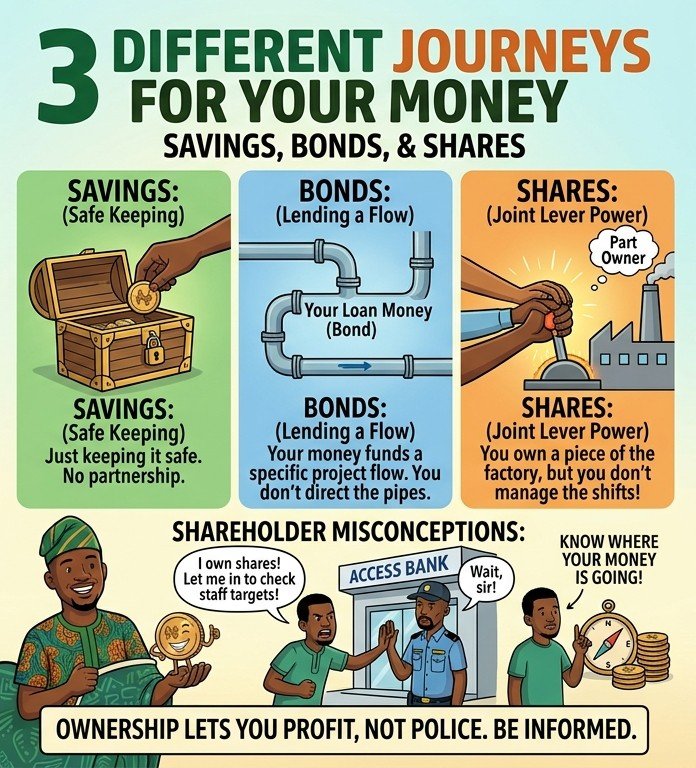
Is a Share/Bond Just Another Kind of Savings Account?
No. A share, a bond and a savings account are three different relationships between you and an organisation, lets explain all three:
Savings account: you deposit money with a bank. The bank agrees to keep it, pay you interest, and give it back when you ask, under the account terms.
Bond: you lend money to a government or a company for a fixed period. They promise to pay you interest at set times and to return your money on a set date.
Share: you become a part-owner. Nobody promises you anything. What you earn depends on how the business does and what other investors will pay for your shares later.
Nigerians create savings accounts in Banks. The Federal Government issues bonds, and some companies issue shares and bonds. One key difference, deposits in licensed banks are protected by the Nigeria Deposit Insurance Corporation (NDIC) up to a limit, but shares and bonds have no such guarantee against price falls.
Side by side
|
Savings account |
Bond |
Share |
What you are |
Depositor |
Lender |
Part-owner |
How you earn |
Interest |
Fixed interest payments |
Dividends and price changes |
Is a return promised? |
Interest rate set by the bank, which can change |
Yes, as written in the bond terms, if the issuer pays |
No |
Can you lose money? |
Unlikely at a licensed bank, within insured limits |
Yes, if the issuer fails to pay, or if you sell early for less |
Yes, the price can fall and dividends can stop |
Getting your money out |
Quick |
Can sell before the end date, at the market price |
Can sell on trading days, but the price may be lower than you paid |
A simple example
Imagine ₦100,000 in each place for one year. The rates and prices below are made up to show the idea. Real rates change often.
|
What it could look like after a year |
Savings account |
At an example 4% interest, you earn ₦4,000 and the ₦100,000 is still there. |
Bond |
At an example 15% interest, you earn ₦15,000 and get the ₦100,000 back at the end date. |
Shares |
₦100,000 buys 10,000 shares at ₦10. If a ₦0.50 dividend is paid, you receive ₦5,000. If the price rises to ₦12, your shares are worth ₦120,000. If it falls to ₦8, they are worth ₦80,000 |
Why this matters to you
Each one does a different job, a savings account is for money you may need soon, a bond suits people who want predictable income over a set period and shares are usually for money you can leave alone for years, because the price can swing in the short term. Many people use more than one and the key mistake is expecting shares to behave like savings, then panicking when the price drops.
What people often get wrong
“A bond is just a savings account with a nicer name.” A bond is a loan to an issuer. If the issuer cannot pay, you can lose money, and if you sell before the end date the price may be lower than you paid.
“Shares always beat savings.” Sometimes they do over long periods, and sometimes they do not, there is no guarantee either way.
The one thing to remember
A savings account is a deposit, a bond is a loan, and a share is ownership. Only a share makes you an owner, and only a share comes with no promise of a return. |
Over to you
Where is your money sitting today: savings, bonds, shares, property, something else? What job is each one doing for you?
This article is for education only and is not investment advice. Company names, prices and figures in the examples are made up to show how things work.