Understanding Shares
Ordinary Shares or Preference Shares: What Is the Difference?
By Oluwadamilola Ojo · 22 November 2026 · 3 min read
Ordinary Shares or Preference Shares: What Is the Difference?
Not all shares are the same. The two main types are ordinary shares and preference shares.
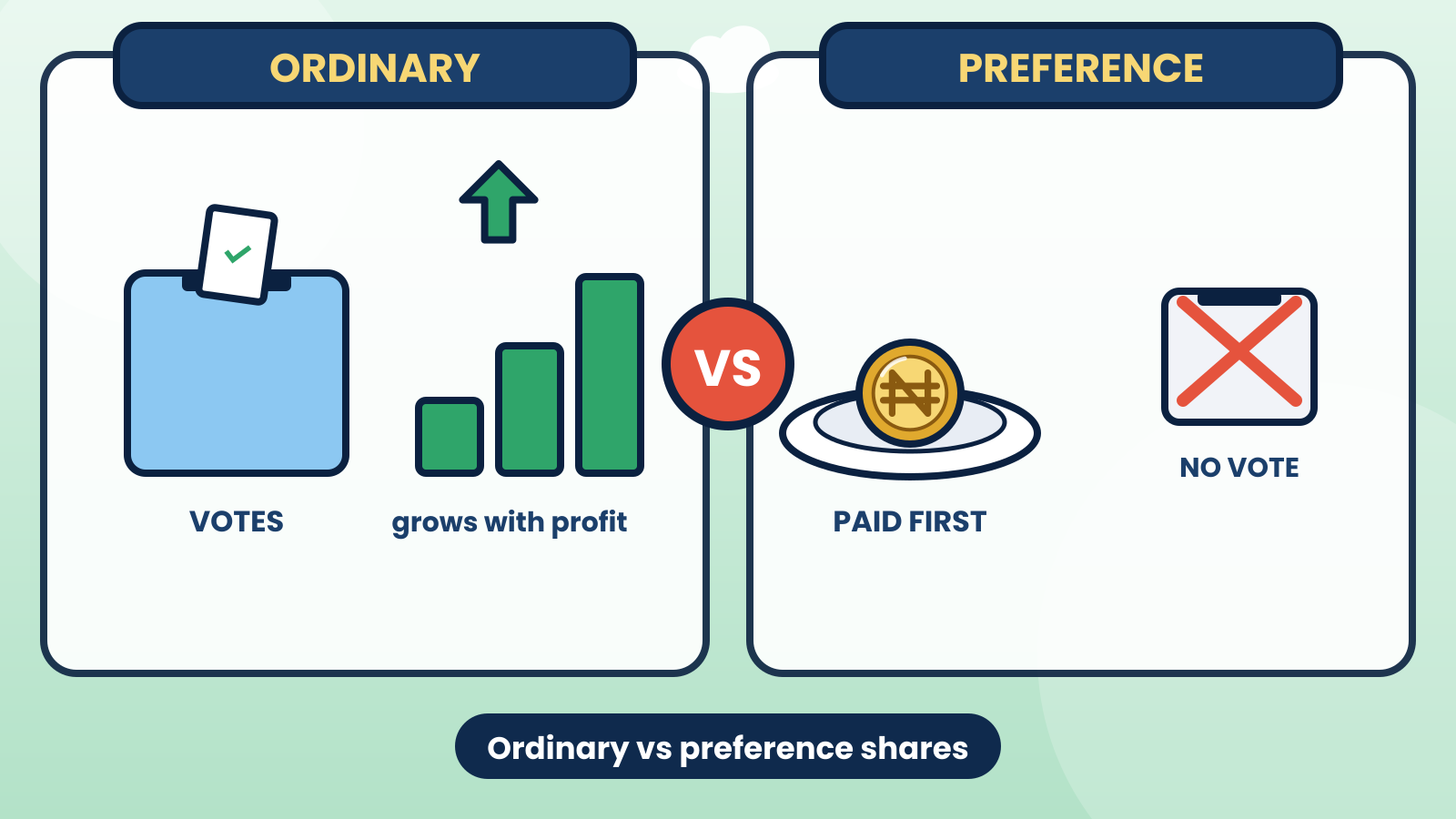
Ordinary shares are what most people mean when they say "shares". They make you a full part-owner: you usually vote, you share in profits through dividends, and you benefit if the company grows. But you are last in line. Dividends are paid only if the board decides to, and if the company fails, you are paid only after everyone else.
Preference shares sit somewhere between a share and a loan. Their holders usually:
Get a fixed dividend, such as 10% of the share's face value each year, paid before ordinary shareholders receive anything.
Stand ahead of ordinary shareholders if the company is wound up, though still behind lenders.
Usually do not vote, except on matters that directly affect their rights.
Do not share in extra growth. If the company does brilliantly, preference holders still get their fixed dividend, while ordinary shareholders can gain much more.
Some preference shares are cumulative: if a dividend is missed, it must be paid later before ordinary shareholders get anything. Some are redeemable: the company will buy them back at a set time.
Here in Nigeria
Almost all the shares traded daily on the NGX are ordinary shares. Preference shares exist in Nigeria but are much less common, and are often issued privately to specific investors or used in company financing deals.
If you find old share papers in your family, they will most likely be ordinary shares. If the certificate says "preference", read the terms carefully, because the rules on dividends and repayment are written into them.
A simple example
A made-up company, Delta Foods, has both types. Each preference share has a face value of ₦10 and pays a fixed 10% dividend, which is ₦1 per share per year.
|
Ordinary shareholder |
Preference shareholder |
Holding |
10,000 ordinary shares |
10,000 preference shares |
Bad year, small profit |
Board pays no ordinary dividend: ₦0 |
Fixed dividend paid first: ₦10,000 |
Normal year |
Ordinary dividend of ₦1.20: ₦12,000 |
Fixed dividend: ₦10,000 |
Excellent year |
Ordinary dividend of ₦3.00: ₦30,000 |
Still ₦10,000 |
Vote at the AGM |
Yes |
Usually no |
If the company is wound up |
Paid after preference holders |
Paid before ordinary holders, after lenders |
Preference shares give steadier income. Ordinary shares give more upside, and more risk.
Why this matters to you
Knowing which type of share you hold tells you what to expect. If you own ordinary shares, you are betting on the company's growth and accepting that dividends can vary. If you own preference shares, you are mainly buying a steady income, closer to lending, with less say and less upside.
What people often get wrong
"Preference shares are better because they come first." They come first for a fixed amount. In good years, ordinary shareholders often do much better.
"Preference dividends are guaranteed." They are paid before ordinary dividends, but a company in real trouble can still miss them. Cumulative terms only mean missed payments are owed later.
"All shares carry a vote." Ordinary shares usually do. Preference shares usually do not, or only in limited cases.
The one thing to remember
Ordinary shares give you ownership, a vote and a share in growth, with more risk. Preference shares give you a fixed income and a place ahead in the queue, with less say and less upside. |
Over to you
If you had to choose between a steady fixed dividend and a share in the company's growth, which would you prefer, and why?