Understanding Shares
What Does a Share Split Change, and What Stays Exactly the Same?
By Oluwadamilola Ojo · 22 November 2026 · 4 min read
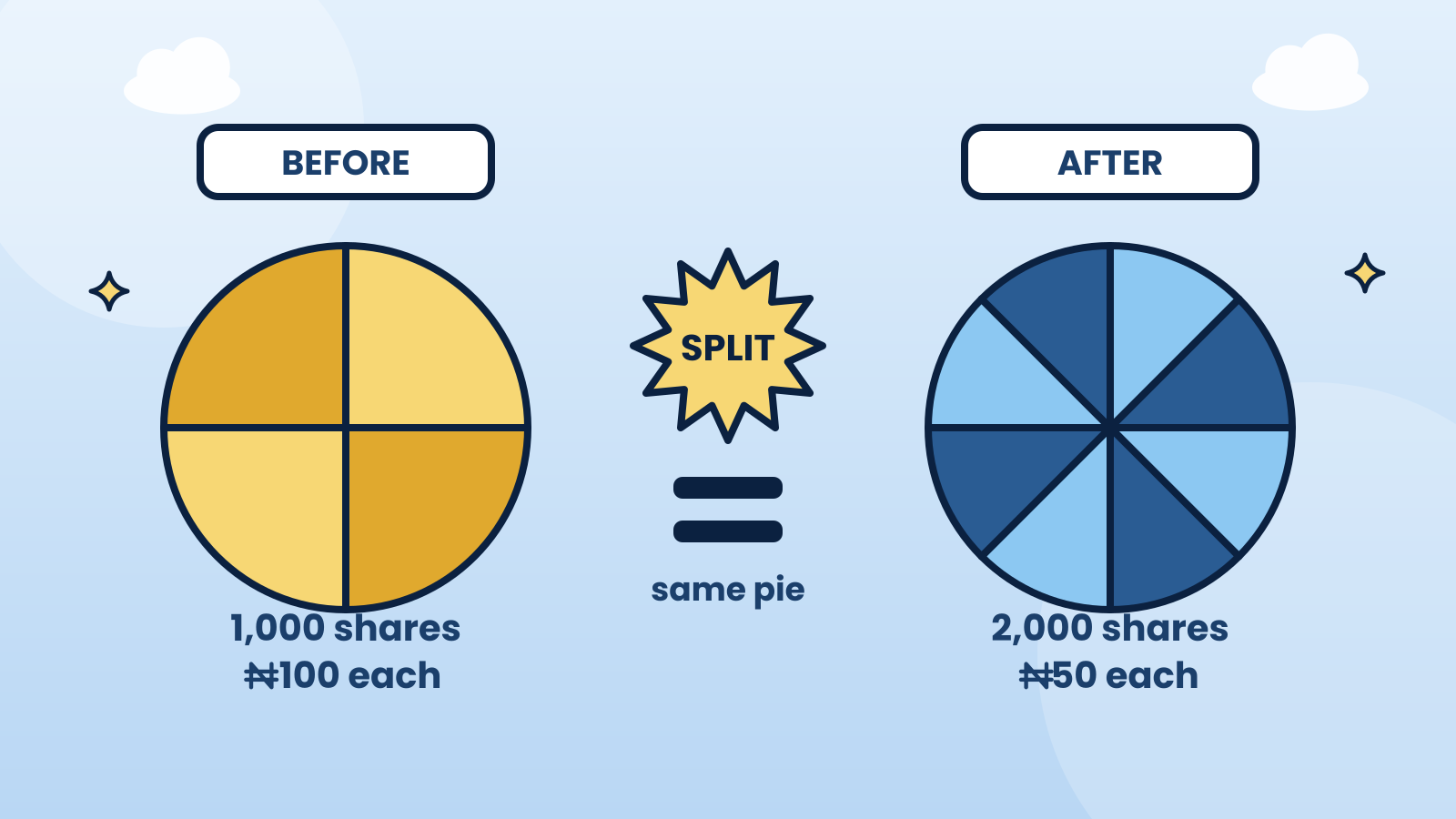
What Does a Share Split Change, and What Stays Exactly the Same?
A share split is when a company divides each of its existing shares into several smaller shares. In a 2-for-1 split, every share you hold becomes two shares, and the price of each roughly halves.
It is like changing a ₦1,000 note into two ₦500 notes. You have more pieces of paper, but the same amount of money.
The opposite also exists. In a share consolidation, also called a reverse split, several shares are combined into one. In a 1-for-10 consolidation, every ten shares become one, and the price of each roughly multiplies by ten.
Here in Nigeria
Share splits and consolidations happen less often on the NGX than bonus issues, but they do happen. A company might consolidate its shares if the price has fallen very low, or split them if the price has become so high that ordinary investors find a single share hard to afford. Changes to a company's share structure require shareholder approval and regulatory clearance, and the registrar updates every shareholder's holding.
Splits and bonus issues produce a similar result on your statement: more shares at a lower price. The difference is in the accounting behind it. A bonus issue converts reserves into new share capital. A split simply divides existing shares into smaller units.
A simple example
Yusuf owns 1,000 shares of a made-up company, Sunrise Telecoms, priced at ₦400. Here is what happens under a split and under a consolidation.
|
Before |
After 2-for-1 split |
After 1-for-10 consolidation |
Shares held |
1,000 |
2,000 |
100 |
Price per share |
₦400 |
About ₦200 |
About ₦4,000 |
Value of holding |
₦400,000 |
About ₦400,000 |
About ₦400,000 |
Yusuf's share of the company |
0.01% |
0.01% |
0.01% |
Dividend per share, if total dividend unchanged |
₦20 |
₦10 |
₦200 |
Yusuf's total dividend |
₦20,000 |
₦20,000 |
₦20,000 |
Every column gives Yusuf the same value, the same share of the company and the same total dividend. Only the number of slices and the size of each slice changed.
There is one practical catch with consolidations. If Yusuf had 1,005 shares, a 1-for-10 consolidation gives him 100 whole shares and leaves 5 shares that cannot become a whole new share. These are called fractional entitlements, and they are usually paid out in cash or handled according to the terms of the consolidation.
Why this matters to you
A split does not make a company cheaper in any real sense, and a consolidation does not make it more valuable. If you see your number of shares change suddenly, check whether there was a split, consolidation or bonus before you assume something went wrong.
Also watch how prices are shown. Charts and price histories usually adjust past prices for splits, so the numbers can look different from what you remember paying.
What people often get wrong
"After a split, the shares are a bargain." The price per share is lower, but each share is a smaller piece. The value has not changed.
"A consolidation means the company is failing." Sometimes it follows a long price fall, so it is worth looking into. But the consolidation itself does not destroy value.
"A split and a bonus are the same thing." The effect on your holding looks similar, but the accounting behind them is different.
The one thing to remember
A share split or consolidation changes how many slices the company is cut into. It does not change the size of the company or your share of it. |
Over to you
If a company you own announced a 2-for-1 split tomorrow, would you feel richer? After reading this, how would you explain to a friend what really changed?