Understanding Shares
What Does "Free Float" Mean, and Why Should a Small Investor Care?
By Oluwadamilola Ojo · 19 November 2026 · 4 min read
What Does "Free Float" Mean, and Why Should a Small Investor Care?
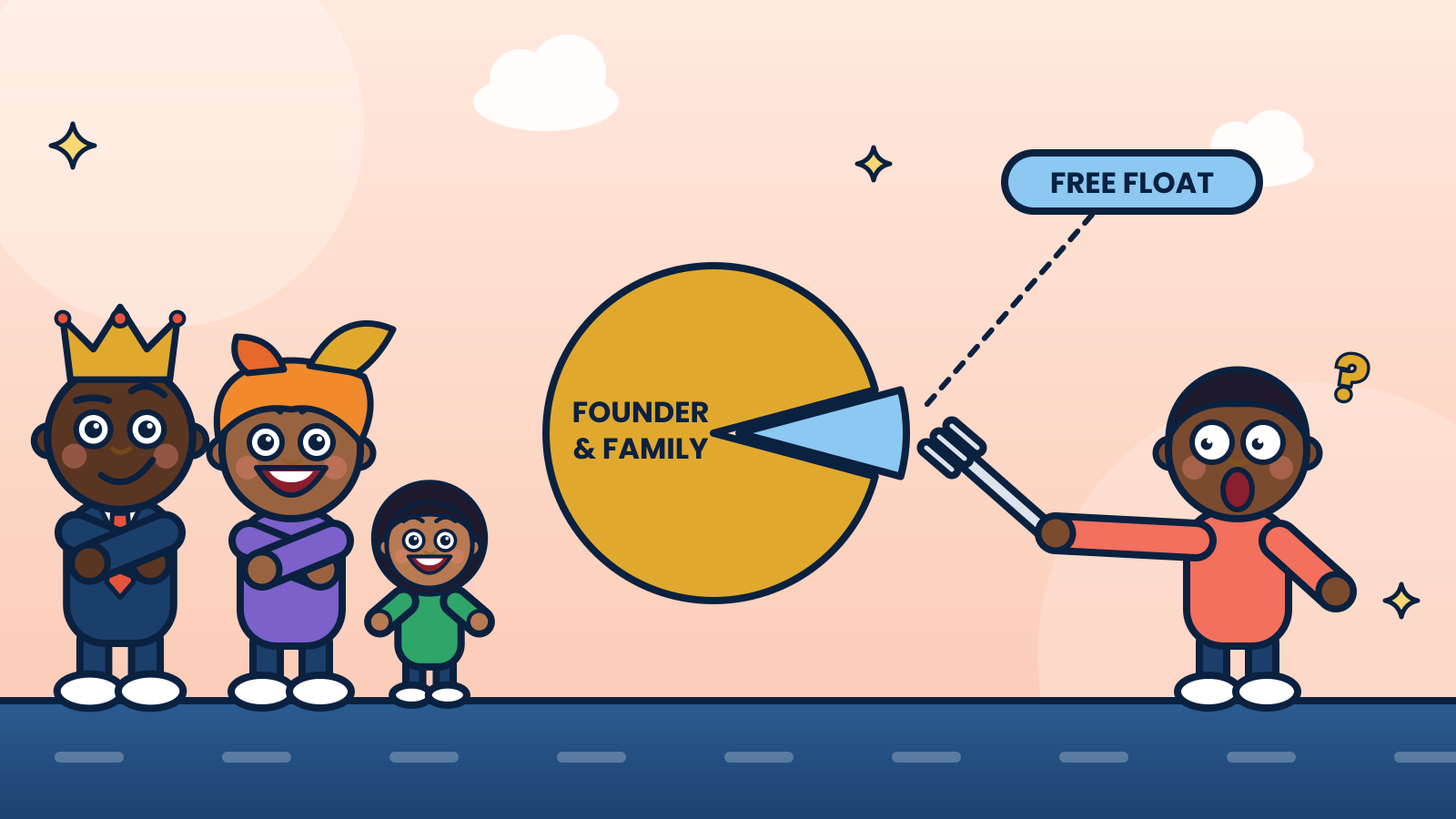
Not every share of a company is available for you to buy. Some are held by people and organisations who are not planning to sell any time soon: the founders, a parent company, the government, or major strategic investors. The shares that are actually available to be traded by the public are called the free float.
Think of a company with 100 shares. If the parent company owns 70 and the founder's family owns 10, only 20 are really out in the market for ordinary investors. That is a free float of 20%.
Free float matters because it affects how easy it is to buy and sell, and how much control ordinary shareholders really have.
Here in Nigeria
Many large Nigerian companies are subsidiaries of foreign groups, or are controlled by a founder or a holding company. In some of them, the public owns only a modest slice. The NGX has rules requiring listed companies to keep a minimum level of free float, so that there is a real public market in their shares. The exact minimums depend on the board the company is listed on and change from time to time. Companies that fall below the requirement may be asked to fix it, for example by selling more shares to the public, or may eventually be delisted.
You will often see free float discussed when a major shareholder decides to buy out the minority and take a company private. In those cases, the small investors who form the free float are the ones who have to decide whether to accept the offer.
A simple example
Two made-up companies with the same total value:
|
Harbour Insurance |
Sunrise Telecoms |
Total shares |
1 billion |
1 billion |
Held by parent company or founders |
200 million (20%) |
900 million (90%) |
Free float |
800 million (80%) |
100 million (10%) |
Typical daily trading |
Active, many buyers and sellers |
Thin, few trades |
Your vote at the AGM |
Part of a large public group |
Easily outvoted by the parent |
If you want to sell ₦5 million worth of Sunrise Telecoms quickly, you may struggle to find enough buyers at a fair price, and your selling could push the price down. With Harbour Insurance, the larger free float usually means more buyers and sellers, so trading is easier.
In Sunrise Telecoms, the parent company decides almost everything, including who sits on the board and how much is paid as dividends. Small shareholders have limited influence, though the law still protects their rights.
Why this matters to you
Before buying a share, it helps to know who else owns it. A small free float can mean:
Harder selling. You may not be able to sell when you want at the price you want.
Sharper price moves. With fewer shares trading, small orders can move the price a lot.
Less influence. The majority owner can usually outvote everyone else.
A small free float is not automatically bad. Many such companies are well run and pay steady dividends. But you should go in with your eyes open.
What people often get wrong
"All of a company's shares are on the market." Usually a large part is held by long-term owners who rarely sell. Only the free float trades.
"A big company always has shares that are easy to buy and sell." A very valuable company can still have a small free float and thin trading.
"If I own shares, the majority owner must listen to me." Your rights are protected by law, but on most votes, the majority owner's votes carry the day.
The one thing to remember
Free float is the part of a company that ordinary investors can actually trade. The smaller it is, the harder it may be to buy or sell, and the less say the public has. |
Over to you
Do you know who the biggest shareholder is in any company you own? Did knowing it change how you think about your investment?
This article is for education only and is not investment advice. Company names, prices and figures in the examples are made up to show how things work. Rules, rates and fees change, so check the current position before acting.