Understanding Shares
What Is "Market Capitalisation", and Why Is a ₦10 Share Not Always Cheap?
By Oluwadamilola Ojo · 19 November 2026 · 4 min read
What Is "Market Capitalisation", and Why Is a ₦10 Share Not Always Cheap?
Market capitalisation, or market cap, is the total value the market places on a company at today's share price. The calculation is simple:
Market capitalisation = number of shares the company has issued × today's share price |
It answers one question: if you could buy every single share of this company today, at today's price, how much would it cost?
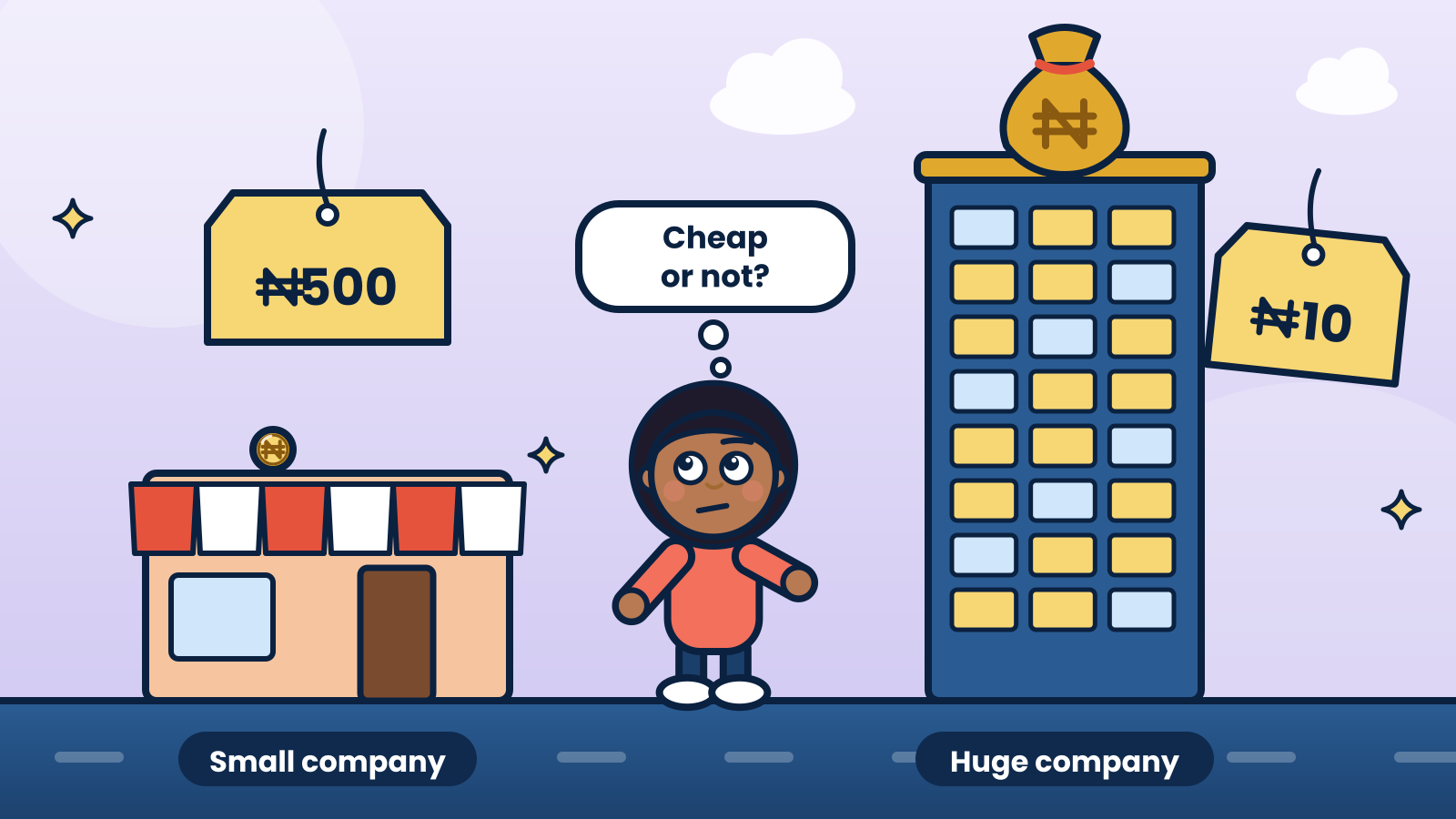
Market cap matters because the share price alone tells you almost nothing about how big or valuable a company is. A company with a ₦5 share price can be worth far more than a company with a ₦500 share price, if it has many more shares.
Here in Nigeria
You will hear market cap used in two ways in Nigeria:
For one company. Business news may say a cement company or a telecoms company is "the most valuable company on the NGX". That is a statement about market cap.
For the whole market. When you read that the total market capitalisation of the NGX has reached a record, it means the combined value of all listed shares at current prices has risen. In October 2026 the NGX's total market capitalisation was reported at a record of about ₦163.1 trillion.
Market cap is also used to group companies. People talk about "large caps", the biggest and usually most heavily traded companies, and "small caps", smaller companies whose shares may trade less often and move more sharply.
A simple example
Compare two made-up companies.
|
Company A: Coastline Cement |
Company B: Delta Foods |
Share price |
₦500 |
₦10 |
Shares issued |
200 million |
50 billion |
Working |
200,000,000 × ₦500 |
50,000,000,000 × ₦10 |
Market capitalisation |
₦100 billion |
₦500 billion |
At first glance, Company A looks "expensive" at ₦500 a share and Company B looks "cheap" at ₦10. But the market values Company B at five times Company A. The share price is just the value of one slice. Company B has cut itself into many more slices.
Now imagine you have ₦100,000. You could buy 200 shares of A or 10,000 shares of B. Owning 10,000 shares may feel bigger, but in both cases you own exactly ₦100,000 worth of a business. What matters is whether that business is worth the price, not how many slices you hold.
Why this matters to you
Market cap helps you compare companies fairly. It stops you from judging a company by its share price, which is one of the most common beginner mistakes in Nigeria, where many people prefer shares priced under ₦10 because they can "buy plenty".
It also hints at risk. Larger companies tend to be more established and their shares easier to buy and sell and Smaller companies can grow faster, but they can also fall faster and be harder to sell. Neither is automatically better, but you should know which you are buying.
What people often get wrong
"A low share price means the share is cheap." A low price only means each slice is small. Whether a share is cheap depends on what you get for the price, such as the company's profits and assets, not on the number itself.
"Market cap is the money the company has." No. Market cap is what investors are willing to pay for the company's shares today. The company's cash is a separate number in its accounts.
"If the market cap rises, the company earned more." Not necessarily. Market cap rises when the share price rises, which can happen because of investor mood, not new profits.
The one thing to remember
A share price on its own does not tell you whether a company is big, small, cheap or expensive. Multiply it by the number of shares, and you see what the market thinks the whole company is worth. |
Over to you
Have you ever bought, or wanted to buy, a share mainly because the price looked low? Looking back, did you know how many shares that company had?