Understanding Shares
When People Say "The Market Is Up Today", What Are They Actually Measuring?
By Oluwadamilola Ojo · 19 November 2026 · 4 min read
When People Say "The Market Is Up Today", What Are They Actually Measuring?
On the news you hear, "The Nigerian market gained 1.2% today." But there are well over a hundred companies on the exchange. Some went up, some went down, some did not move. So what exactly went up by 1.2%?
The answer is an index. An index is a single number that summarises how a group of shares moved. The most quoted one in Nigeria is the NGX All-Share Index (ASI).
You can think of it like the average score of a whole class. Some students did well, others did badly, but the class average tells you how the class as a whole performed. The difference is that in an index, the bigger companies count for more, because the index is usually weighted by market capitalisation.
Here in Nigeria
The NGX All-Share Index tracks the prices of all ordinary shares listed on the main boards of the exchange. Because it is weighted by market cap, a handful of very large companies, such as major telecoms, cement and banking names, have a big influence on its daily movement.
The NGX also publishes other indices that track smaller groups:
Sector indices, for example banking, insurance, consumer goods, industrial goods and oil and gas.
Indices of the largest companies, such as an index of the 30 biggest.
Specialist indices, including the NGX Lotus Islamic Index, which tracks Shariah-compliant shares. We cover that one in detail later in the series.
When someone says "the market is up", they usually mean the All-Share Index rose.
A simple example
Imagine a tiny market with just three made-up companies. The index is weighted by market cap.
Company |
Market cap |
Weight in index |
Price change today |
Contribution |
Big Telecom |
₦600 billion |
60% |
+2% |
60% × 2% = +1.2% |
Mid Bank |
₦300 billion |
30% |
-1% |
30% × -1% = -0.3% |
Small Foods |
₦100 billion |
10% |
+5% |
10% × 5% = +0.5% |
Index |
|
100% |
|
+1.4% |
The index rose 1.4%. Notice that Small Foods jumped 5% but added less to the index than Big Telecom's 2% rise, because it is a much smaller company. And Mid Bank shareholders lost money even on a day "the market was up".
Why this matters to you
The index tells you the mood and direction of the market as a whole. It is useful for understanding the big picture and for comparing how your own shares are doing.
But your portfolio is not the index. If you own three or four companies, your result can be very different from the headline number, up or down. Do not feel rich because the index rose, or panic because it fell, without checking your own holdings.
What people often get wrong
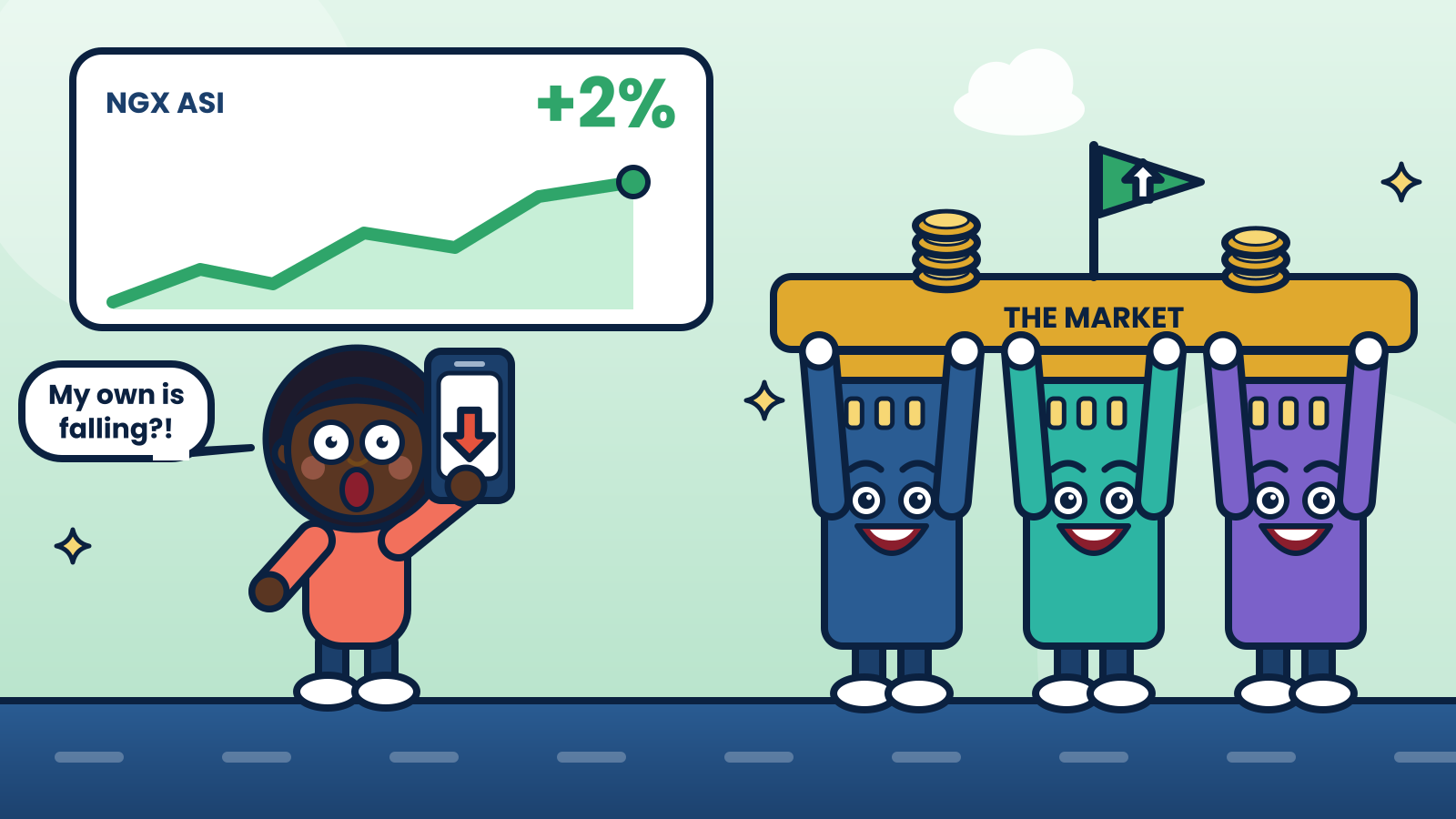
"The market is up, so my shares are up." Not necessarily. The index can rise while many individual shares fall, especially if a few big companies are driving it.
"The index is the average of all share prices." It is weighted by market cap, so large companies count for much more than small ones.
"A record high index means everything is expensive." A rising index can reflect real growth in profits, inflation, or investor enthusiasm. It needs interpreting, not just reading.
The one thing to remember
The All-Share Index is a summary of the whole market, heavily shaped by its biggest companies. It tells you the direction of the market, not the direction of your own shares. |
Over to you
Next time you hear that the market rose or fell, check one share you own or follow. Did it move the same way as the index?