The Foundations
When You Buy Shares, Who Actually Receives Your Money?
By Oluwadamilola Ojo · 15 November 2026 · 3 min read
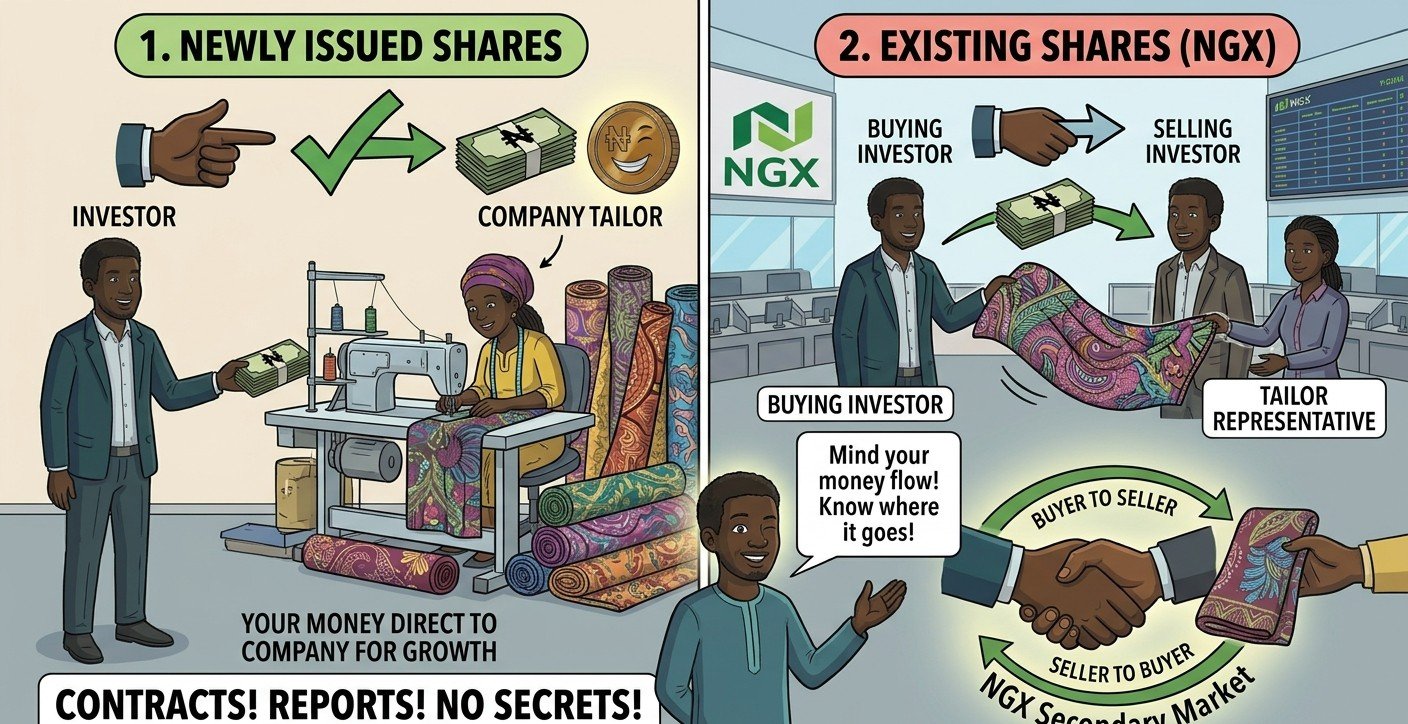
When You Buy Shares, Who Actually Receives Your Money?
It depends on where you buy. There are two markets, and they work differently.
Primary market: a company creates new shares and sells them to investors for the first time. Your money goes to the company, less the costs of running the offer.
Secondary market: investors trade existing shares with each other on the exchange. Your money goes to the seller. The company does not receive it.
Think of a new phone from the manufacturer, and a used phone from another person. When you buy new, the maker is paid and when you buy used, the previous owner is paid.
Here in Nigeria
When a company offers new shares to the public, this is called a public offer or an IPO (initial public offering), and a company already listed can do a further offer or a rights issue. You normally apply through a stockbroker or the parties named in the offer documents, and the money goes to the company. Banks have used offers like these to raise fresh capital and a good example of this is the famous Dangote Refinery IPO
Most buying and selling you do day to day on the Nigerian Exchange (NGX) is secondary-market trading, your broker finds another investor on the other side, and CSCS moves the shares from them to you.
A simple example
Naija Foods PLC is a made-up company. The numbers are for illustration only.
|
Primary market (new shares) |
Secondary market (existing shares) |
What happens |
Naija Foods issues 10 million new shares at ₦5 each |
Funke buys 1,000 shares from Emeka on the exchange at ₦8 each |
How much changes hands |
10,000,000 × ₦5 = ₦50 million |
1,000 × ₦8 = ₦8,000 |
Who receives the money |
Naija Foods, less the costs of the offer |
Emeka, less his fees |
What Naija Foods receives from this |
₦50 million (less costs) |
Nothing |
Why this matters to you
In the primary market you buy at the price the company sets for the offer. In the secondary market, the price is set by other investors and changes all the time. Knowing which one you are in tells you who you are paying and what price you are paying. It also explains why a company does not get richer each time its share trades.
What people often get wrong
“When I buy shares, the company gets my money.” Only when you buy new shares in the primary market. On the exchange you are buying from another investor.
“Trading on the exchange funds the company.” Not directly. The company benefits when it raises new money, not when shares change hands between investors.
The one thing to remember
Buying shares does not always mean you are giving money to the company. Sometimes you are buying ownership from another investor. |
Over to you
Have you ever applied for shares in a new offer? Or have you only ever bought from the market? What was the difference?
This article is for education only and is not investment advice. Company names, prices and figures in the examples are made up to show how things work.