The Foundations
Who Really Decides What a Share Is Worth?
By Oluwadamilola Ojo · 15 November 2026 · 3 min read
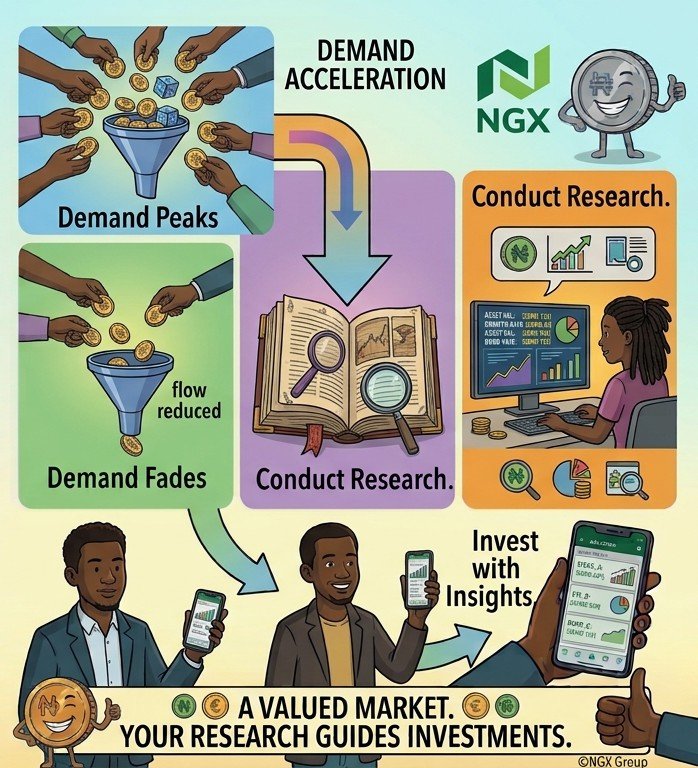
Who Really Decides What a Share Is Worth?
Nobody sets the price of a share by royal decree, the price is simply what buyers and sellers agree on.
It works like tomatoes at the market. When tomatoes are scarce and many people want them, the price goes up. When there are lots of sellers and few buyers, the price comes down. Shares work the same way.
A buyer says the highest price they are willing to pay. This is the bid.
A seller says the lowest price they will accept. This is the ask.
When a bid and an ask meet, a trade happens. The price of that trade becomes the latest market price.
There is a second idea to keep in mind. Market price is what people are paying today. Value is what you believe the business is really worth, based on its profits, its debts and its future and the two are not always the same.
Here in Nigeria
On the Nigerian Exchange, prices are shown in naira and change as orders meet during trading days. One thing catches many beginners out: the price per share does not tell you how big a company is. A company with a ₦5 share price and billions of shares can be far larger than one with a ₦500 share price and only a few million shares. You have to look at the number of shares too.
A simple example
Here is a made-up snapshot of orders for one share.
Buyers are willing to pay (bids) |
Sellers want at least (asks) |
₦19.50 for 2,000 shares |
₦20.00 for 1,500 shares |
₦19.00 for 5,000 shares |
₦20.50 for 3,000 shares |
No trade happens yet, because the highest bid (₦19.50) is below the lowest ask (₦20.00). If a buyer raises their bid to ₦20.00, it meets the seller and the share trades at ₦20.00. That becomes the market price.
Now suppose Tunde studies the company and believes it is worth ₦30 a share because profits are growing. Chioma studies the same company and believes it is worth ₦15 because it carries heavy debt. At ₦20, Tunde sees a bargain and Chioma sees an overpriced share. The trade happens because they disagree. Both could be right or wrong, and time will tell.
Why this matters to you
The price on your screen is an opinion shared by many people on a given day. It is not a verdict. A low price is not automatically a bargain, and a high price is not automatically a rip-off. Before you decide, learn what the business does and how it earns money.
What people often get wrong
“A cheap share price means a good deal.” A ₦2 share can be expensive if the company earns very little. A ₦200 share can be cheap if the company earns a lot.
“The share price is what the company is worth.” The price tells you what buyers and sellers agree on today, and that can sit well above or well below the real worth of the business.
The one thing to remember
A share’s market price is set by buyers and sellers. It is not automatically the same as what the business is really worth. |
Over to you
Think of something you bought because the price looked low. What did you check before paying, and would you check the same things for a share?
This article is for education only and is not investment advice. Company names, prices and figures in the examples are made up to show how things work.