Understanding Shares
Why Can't You Just Buy Shares Yourself Without a Stockbroker?
By Oluwadamilola Ojo · 19 November 2026 · 4 min read
Why Can't You Just Buy Shares Yourself Without a Stockbroker?
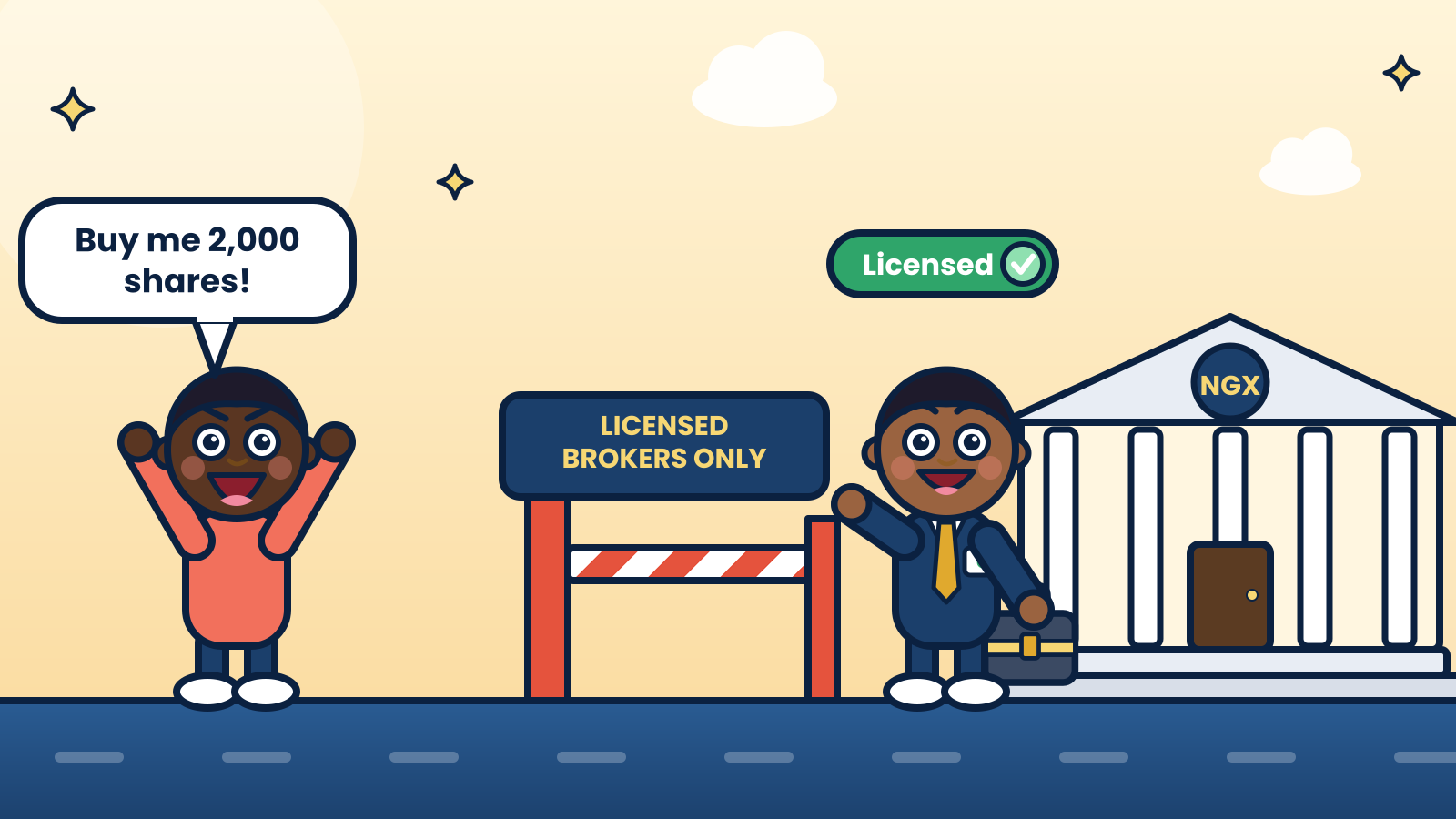
When you want to buy shares on the Nigerian Exchange, you cannot log into the exchange and press "buy". Only licensed firms, known as dealing members of the exchange, are allowed to place orders directly. These firms are stockbrokers. They are the doorway between you and the market.
A stockbroker does several things on your behalf:
Opens your account and your CSCS account, and checks your identity.
Takes your orders and sends them to the exchange.
Gets your trades settled, so shares reach your account and money reaches the seller.
Holds your cash for investing in a client account, separate from the firm's own money.
Sends you contract notes and statements confirming what you bought and sold, at what price, and the fees.
May give research or advice, if licensed and if you ask for it.
In return, the broker charges a commission on each trade.
Here in Nigeria
Nigerian brokers range from long-established firms with offices in Lagos and other cities to newer firms that operate mainly through mobile apps. Some apps you may know are not brokers themselves but partner with a licensed broker in the background. That is allowed, but you should know which licensed firm is actually holding your account.
Before choosing a broker, check two things:
Is the firm registered with the SEC?
Is it a dealing member of the NGX, or does it work through one?
A good broker should also be clear about its fees, give you a contract note after every trade, and help you get a CSCS statement when you ask.
A simple example
Emeka wants to buy 2,000 shares of a made-up company, Coastline Cement, at ₦50 each. Fees vary between brokers and are set within limits. The percentages below are made up to show the idea.
Item |
Working |
Amount |
Value of shares |
2,000 × ₦50 |
₦100,000 |
Broker's commission (say 1%) |
1% of ₦100,000 |
₦1,000 |
Other regulatory and exchange charges (say 0.3%) |
0.3% of ₦100,000 |
₦300 |
Total Emeka pays |
₦100,000 + ₦1,000 + ₦300 |
₦101,300 |
The contract note will show each of these lines. If Emeka sells later, there will be charges on the sale too. That is why buying and selling often eats into returns.
Why this matters to you
Your broker is one of the most important relationships you will have as a shareholder. A good one makes your life simple. A careless one can leave you with wrong records, unexplained fees or slow payments. Choose carefully, read your contract notes, and keep them.
Remember also that your broker works for you, but it is also a business. If a broker pushes you to trade often, ask yourself who benefits from all that trading.
What people often get wrong
"My broker can guarantee me a return." No broker can honestly guarantee returns on shares. Anyone who promises this is breaking the rules or lying.
"If my broker shuts down, I lose my shares." Your shares are in your CSCS account, in your name. They can be moved to another broker. Cash held by a broker should be kept in a separate client account, which is why choosing a regulated firm matters.
"A good broker always tells me what to buy." Some brokers give advice, and some only execute orders. Either way, the final decision, and the risk, is yours.
The one thing to remember
A stockbroker is your licensed doorway to the market. Choose a registered one, understand the fees, and keep every contract note it sends you. |
Over to you
If you had to choose a broker tomorrow, what would matter most to you: low fees, a good app, a physical office, or someone you can call?