Understanding Shares
Why Did Nigeria Take Shares Off Paper, and What Does "Dematerialisation" Mean?
By Oluwadamilola Ojo · 19 November 2026 · 4 min read
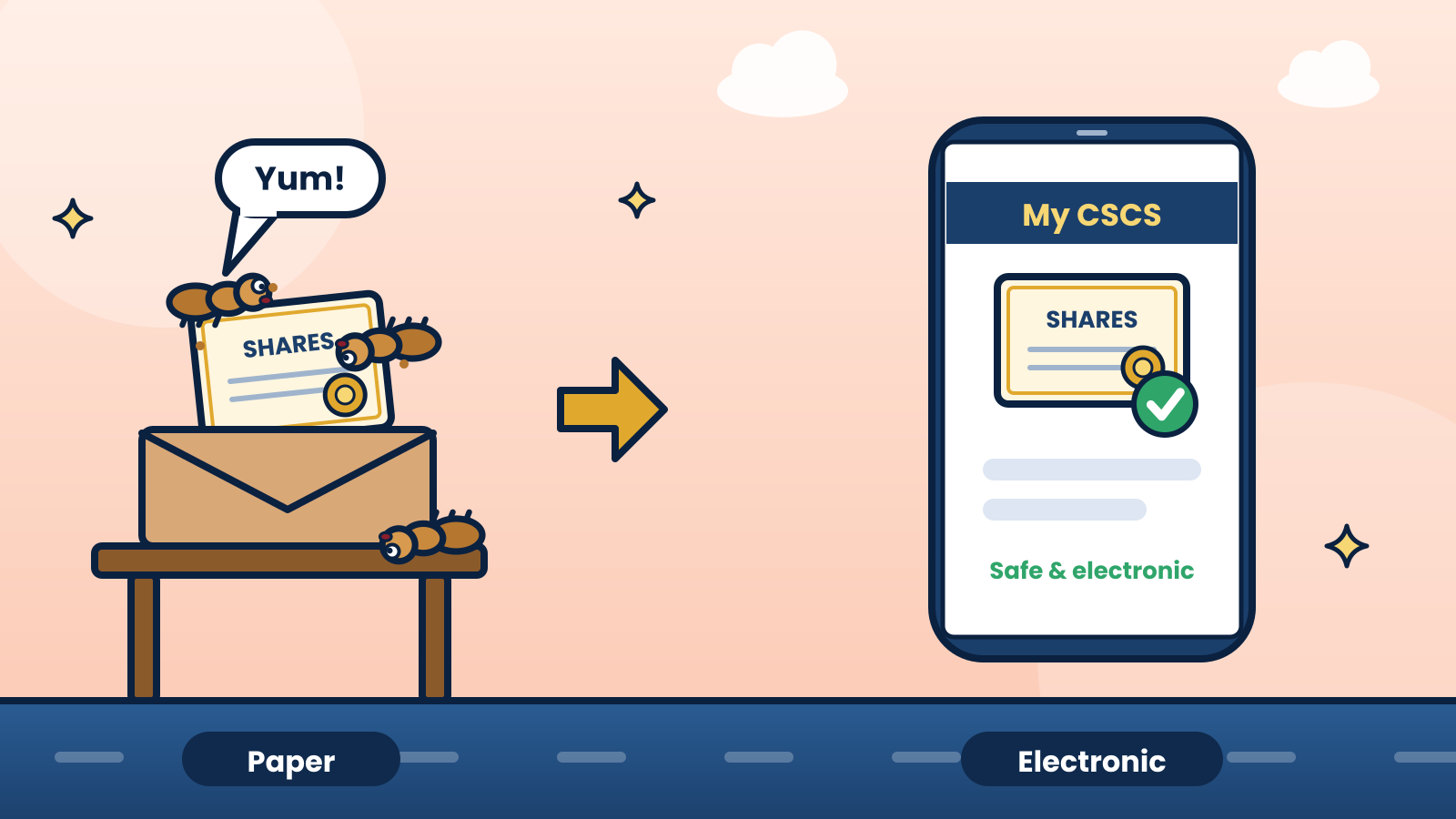
Why Did Nigeria Take Shares Off Paper, and What Does "Dematerialisation" Mean?
Dematerialisation is a long word for a simple idea: taking ownership off paper and recording it electronically. Instead of a printed certificate in your drawer, your shares become an entry in a secure central computer system, linked to your name and your account.
Think of how banking changed. Years ago, many people kept passbooks, and every deposit was written by hand. Today your balance lives in the bank's system, and your app or statement simply shows you what that system says. Your money did not disappear when the passbook went, It just moved to a safer, faster record. Shares went through the same change.
Why make the change? Paper had real problems:
Paper can be lost, burnt, eaten by termites or stolen. Every lost certificate meant affidavits, indemnities and delays.
Paper can be forged. Fake certificates and forged transfer forms were a real fraud risk.
Paper is slow. Selling meant moving physical documents between the seller, the broker and the registrar. Transfers could take weeks.
Paper makes mistakes hard to fix. Names were misspelt, addresses went out of date, and nobody could see the whole picture.
With electronic records, a trade can be matched, settled and recorded in days, the risk of a fake certificate falls away, and your holding can be checked on a statement.
Here in Nigeria
Nigeria's central record for listed shares is the Central Securities Clearing System, known as CSCS. It was set up in the 1990s to clear and settle trades on the exchange and to hold shares electronically. Over the years, the market moved away from paper so that today shares traded on the Nigerian Exchange are held and moved electronically.
For people who already had certificates, the move was not automatic. To get paper shares into the system, the owner, through a stockbroker, had to submit the certificate to the company's registrar for verification. Once the registrar confirmed that the certificate was genuine and matched the register, the shares were credited to the owner's CSCS account.
Many people never did this. Their shares are still on the registrar's books under their old details, but they are not in CSCS. That is one reason many Nigerians cannot "see" shares that they, or their parents, actually own.
A simple example
Here is how a paper holding becomes an electronic one. The person and details are made up, and the exact documents and timelines vary by broker and registrar.
Step |
Who does it |
What happens |
1. Open or confirm a CSCS account |
Tunde, through a stockbroker |
He gets a CSCS account number linked to his name and BVN |
2. Submit the certificate |
The broker, on Tunde's behalf |
The broker sends the certificate and forms to the company's registrar |
3. Verification |
The registrar |
The registrar checks the certificate against the register of members |
4. Credit |
Registrar and CSCS |
The shares are moved into Tunde's CSCS account |
5. Confirmation |
CSCS and the broker |
Tunde sees the shares on his CSCS statement and can now sell if he wants |
If the name on the certificate does not match Tunde's current documents, or the certificate is lost, step 3 takes longer and may need extra documents. We cover name mismatches later in the series.
Why this matters to you
If you or your family hold paper certificates, those shares are not ready to use until they are dematerialised. You cannot sell them on the exchange, and you may not be receiving their dividends properly. Dematerialising also puts the holding in one place where you can see it, alongside any shares you buy in future.
It is also a protection. Electronic shares are harder to steal by forging a document, and changes to your account leave a record.
What people often get wrong
"Dematerialisation means the government took my shares." No. Your ownership did not change. Only the way it is recorded changed. The shares remain yours.
"Since the system is electronic, all my old shares must already be in it." Not necessarily. Paper holdings had to be submitted and verified. If nobody did that, the shares may still be sitting only on a registrar's books.
The one thing to remember
Dematerialisation did not change who owns a share. It changed where the ownership is written down, from paper in your drawer to a secure electronic record. |
Over to you
Have you ever tried to convert old share certificates into electronic form? What was the hardest part: the documents, the name, or simply knowing where to start?
This article is for education only and is not investment advice. Company names, prices and figures in the examples are made up to show how things work. Rules, rates and fees change, so check the current position before acting.