The Foundations
Why Is my Share Price Moving When the Company Has Said Nothing?
By Oluwadamilola Ojo · 15 November 2026 · 3 min read
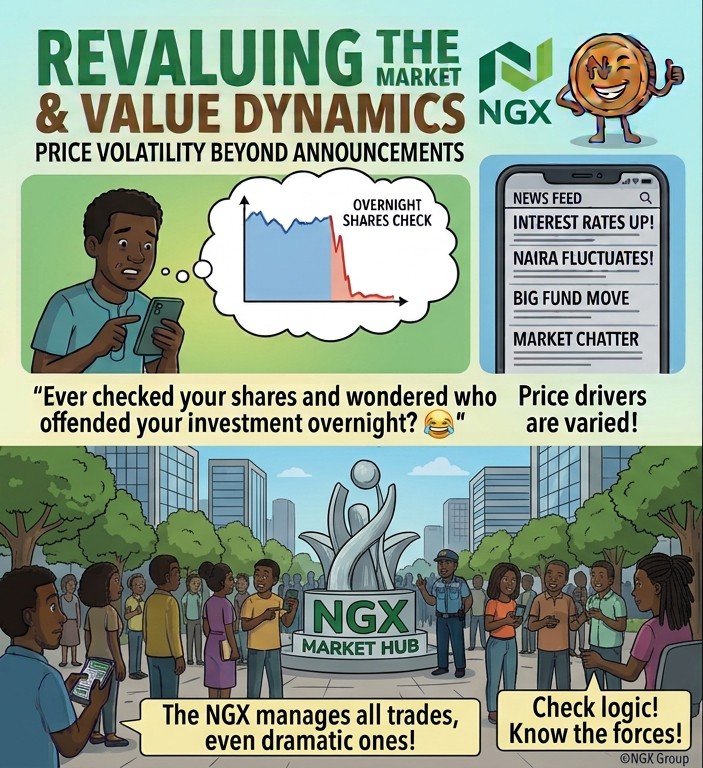
Why Is a Share Price Moving When the Company Has Said or Done Nothing?
Share prices do not move only when a company makes an announcement. They move all the time, because the market is made of people, and people are always guessing about the future.
A share price reflects two things: what has already happened, and what investors expect to happen next. When expectations change, the price can change, even if the company itself has done nothing new.
Here are common reasons a price moves without company news:
More buyers than sellers (or the other way round). Simple demand and supply.
Interest rates. When treasury bills and bonds pay more, some investors move money out of shares. When they pay less, money often flows into shares.
Inflation and the naira. These change business costs and what investors expect companies to earn.
Government policy and politics. Budgets, tax changes, fuel and trade rules, and elections.
Big investors. When a large fund buys or sells, the price can move.
Mood. Fear and excitement spread, and prices follow.
Few trades. Some shares trade rarely, so one large order can push the price.
Here in Nigeria
Many of these show up clearly on the Nigerian Exchange. A change in the naira exchange rate can lift or hurt companies that import their materials, Election seasons often bring caution and some listed shares trade so rarely that a single large order can move the price by several naira, while a popular share may change hands thousands of times a day.
A simple example
Naija Foods PLC is a made-up company. The numbers are for illustration only.
Day |
Price |
What happened |
Monday |
₦40.00 |
Nothing from the company |
Wednesday |
₦42.00 |
Interest rates on government securities dip. Some investors look at shares again |
Friday |
₦44.00 |
Two large buyers place orders. No company announcement all week |
The price rose ₦4, which is 10%. If you owned 1,000 shares, they moved from ₦40,000 to ₦44,000 in a week. Nothing about the bakery, factory or business changed.
Thin trading works the same way. If only 3,000 shares trade in a day and someone buys 2,000 of them, the price can jump from ₦40 to ₦41 on that one order alone.
Why this matters to you
If you check your portfolio every day, you will see movement that means very little. Before you celebrate a rise or panic about a fall, ask one question: did the business change, or did the mood change? If the business has not changed, a price move may not tell you much.
What people often get wrong
“My share fell, so the company must be in trouble.” It might be. It might also be a market-wide mood swing. Check the company’s own results.
“My share is rising, so the company must be doing well.” Prices can rise for reasons that have nothing to do with the company.
The one thing to remember
A falling share price does not automatically mean a company is failing, just as a rising share price does not automatically mean it is doing well. |
Over to you
Have you ever seen a share you own change price and had no idea why? What did you do about it?
This article is for education only and is not investment advice. Company names, prices and figures in the examples are made up to show how things work.